Flanges are critical components of piping systems in many industries, with carbon steel flanges showing up in the thousands throughout oil refineries, power plants, and petrochemical facilities. Structural integrity and cost-effectiveness have made carbon steel flanges the preferred choice of engineers.
Flanges must be selected carefully to the right grade, type, and face configuration, as using the wrong choice can result in large costs to repair the piping system or to address safety issues.
The goal of this guide is to aid your selection of flanges for your systems.
Why Carbon Steel?
In the vast majority of systems, carbon steel flanges are able to withstand the required pressures and temperatures without the need for expensive and high performance alloys. Compared to stainless steel and nickel alloy flanges, carbon steel flanges are especially cost effective.
These features create a dominance of carbon steel flanges in numerous fields.
Strength-to-weight advantage: Carbon steel can be safely used in very high pressure Class 2500 piping systems without the use of bulky piping.
Weldability: Carbon steel can be welded to standard piping materials.
Cost efficiency: Compared to duplex and stainless steel flanges, carbon steel offer a large cost advantage when made in bulk.
DRAG INFluence
Grades like ASTM A105, A350 LF2, and A694 are available almost everywhere, leading to shorter lead times on big, critical projects.
However, carbon steel requires surface protection in corrosive environments. Depending on the service conditions, coatings of FBE, 3PE, or zinc may be used.
Carbon Steel Flanges: Types and Applications
Flanges do not serve the same application and using an incorrect one is one of the most common piping design mistakes.
Weld Neck Flanges (WNRF)
Used for high temperature and high pressure systems, the long tapered hub in these flanges allows stress to be transferred to the pipe, making them appropriate for oil and gas processing.
Slip-On Flanges (SORF)
The most easy to align and install, these flanges are recommended for low pressure applications where the need for flanges is minimized.
Blind Flanges (BLRF)
These flanges are designed to close the end of a pipe and are essential to maintaining the shut down of a pipeline. They are also critical in a pressure test for permitting access to the pipe in the future.
Socket Weld Flanges (SWRF)
Used for high pressure systems, these flanges are designed for piping which fits in the recessed section and provides a secure connection.
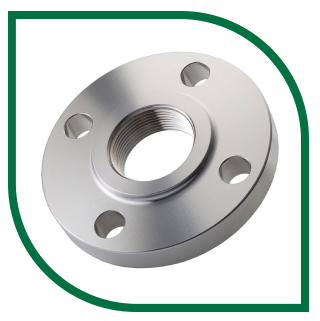
Threaded Flanges
These flanges are also suitable for use in high pressure systems. They are designed to eliminate welding since piping is connected by a screw. These flanges are used in problematic systems, where welding is not permitted.
Key Standards Governing Carbon Steel Flanges
When you purchase carbon steel flanges, you need to verify standards to ensure the safety of your employees and your project.
StandardScope
ASME B16.5Flanges NPS ½” to 24″ASME B16.47Large diameter flanges up to 60″MSS SP-44High-strength steel pipe flangesEN 1092-1European pressure equipment applicationsAPI 6AWellhead and Christmas tree equipment
For carbon steel flanges, Ambient applications will reference ASTM A105, while A350 LF2 will have liquid metal limitations of -50°F.
4 Things to Verify Before Ordering CS Flanges
Pressure class — what is the class rating (150# to 2500#) and what is the operating pressure?
Face type — Flanges can have raised face (RF), flat face (FF), or a ring type joint (RTJ).
Material test certificates — Traceability manifests as EN 10204 3.1 certificates.
Coating requirements — what will the service environment be and what will the surface finish be?
Selecting a Manufacturer
No matter how stringent your requirements are on carbon steel flanges, if the manufacturer cannot supply traceable testing, you haven’t met requirements. Therefore, NACB-approved lab testing, IBR approvals, as applicable, and an established export history to many countries is what you should look for when choosing a supplier.
Because of India’s ASME-compliant manufacturing and cost benefits compared to other countries, India has become one of the top suppliers of forged CS flanges.
Congrats! You’ve Completed This Blog. 👏